Backyard play equipment eats budgets fast if you buy the wrong thing twice. This guide breaks down what actually holds up in an Australian backyard, what to skip, and where the savings make sense in 2026.
- Trampolines and water play tables are the safest first buys for outdoor toys for backyard play in 2026 — both score well on weather resistance and age range.
- Skip swing sets under a $150 budget; frame thickness under 32mm bends within a season of Australian sun.
- UV-stabilised plastic and AS/NZS-rated nets separate toys that last two summers from toys that crack after one.
- Hot Deal Warehouse lists activewear, toys and home essentials at up to 30% off, which changes the math on mid-range picks.
Why this matters
Backyard toys are a repeat-purchase category disguised as a one-off buy. A trampoline bought on the wrong spec gets replaced within 18 months; a sandpit with no lid fills with leaves and mozzie larvae by week three. The gap between a toy that survives an Australian summer and one that doesn't usually comes down to three things: material grade, weight limit, and whether the safety certification is real or just printed on the box.
Most backyard toy failures aren't design failures — they're mismatch failures. A trampoline built for a 60kg child gets three teenagers on it during a birthday party. A sandpit meant for a 2-year-old becomes a football goal for an 8-year-old. Buying for the actual household, not the aspirational one, is the single biggest lever here.
You can browse the current range of outdoor and backyard categories at Hot Deal Warehouse before working through the criteria below — it helps to know what's in stock while you read.
Who this is for
This guide is for parents and caregivers with a backyard, courtyard, or shared outdoor space who want play equipment that survives more than one season without becoming a tripping hazard or a landfill trip. It assumes a household budget that favours value over premium branding — the kind of shopper who reads a spec sheet before a logo. If your yard is under 20 square metres, skip straight to the sandpit and water play sections; the trampoline and swing set advice won't apply.
What to look for in outdoor toys for backyard play
Weather resistance
Australian UV exposure degrades cheap plastic fast — untreated polypropylene can go brittle within one summer. Look for products that specify UV-stabilised material; it's usually printed directly on the packaging or product description. This single spec predicts more about longevity than price does.
Age-appropriate weight limits
Every trampoline, ride-on toy, and swing has a stated weight capacity, and it's not a suggestion. A 12ft trampoline rated for 100kg total load will sag and stretch its mat if two adults get on for a photo. Match the rating to who will actually use it, including older siblings and visiting cousins.
Assembly time and tools required
A toy that needs two hours and a socket set to assemble is a toy that sits in the garage for a week. Anything under 30 minutes with tool-free clips is the realistic bar for a weekend buy — check the listing for an assembly time estimate before ordering.
Safety certification
AS/NZS 4989 covers trampolines sold in Australia; look for that reference specifically, not a generic "safety tested" claim. For smaller toys, check for choking-hazard age labelling (0-3, 3+, 6+) rather than a vague "suitable for children" line.
Storage footprint
A swing set that needs permanent ground anchoring is a different commitment than a fold-flat sandpit. If the yard doubles as a driveway extension or entertaining space, prioritise anything that folds, stacks, or deflates.
Value per play hour
A $40 sprinkler toy used three times a week for a summer beats a $300 swing set used twice a month. Think in cost-per-use, not sticker price, especially when comparing categories rather than specific units.
Top picks by category
Trampolines — the backyard staple. Sizes typically run 8ft to 14ft, with safety-net enclosures standard on anything sold for backyard use in 2026. A mid-size 10ft unit with a 100-120kg weight rating covers most single-child or two-sibling households. Buy if the yard has at least 3.5m of clearance on all sides; Skip if your space is under that, because a cramped trampoline is the top cause of enclosure-net injuries.
Water play tables and sprinkler toys — the summer cooler. These run on standard garden hose pressure and suit ages 1-6. Expect a season or two of daily summer use before the plastic starts to fade. Buy for anyone under a hot-climate postcode with kids under six; low cost, high play-hour ratio.
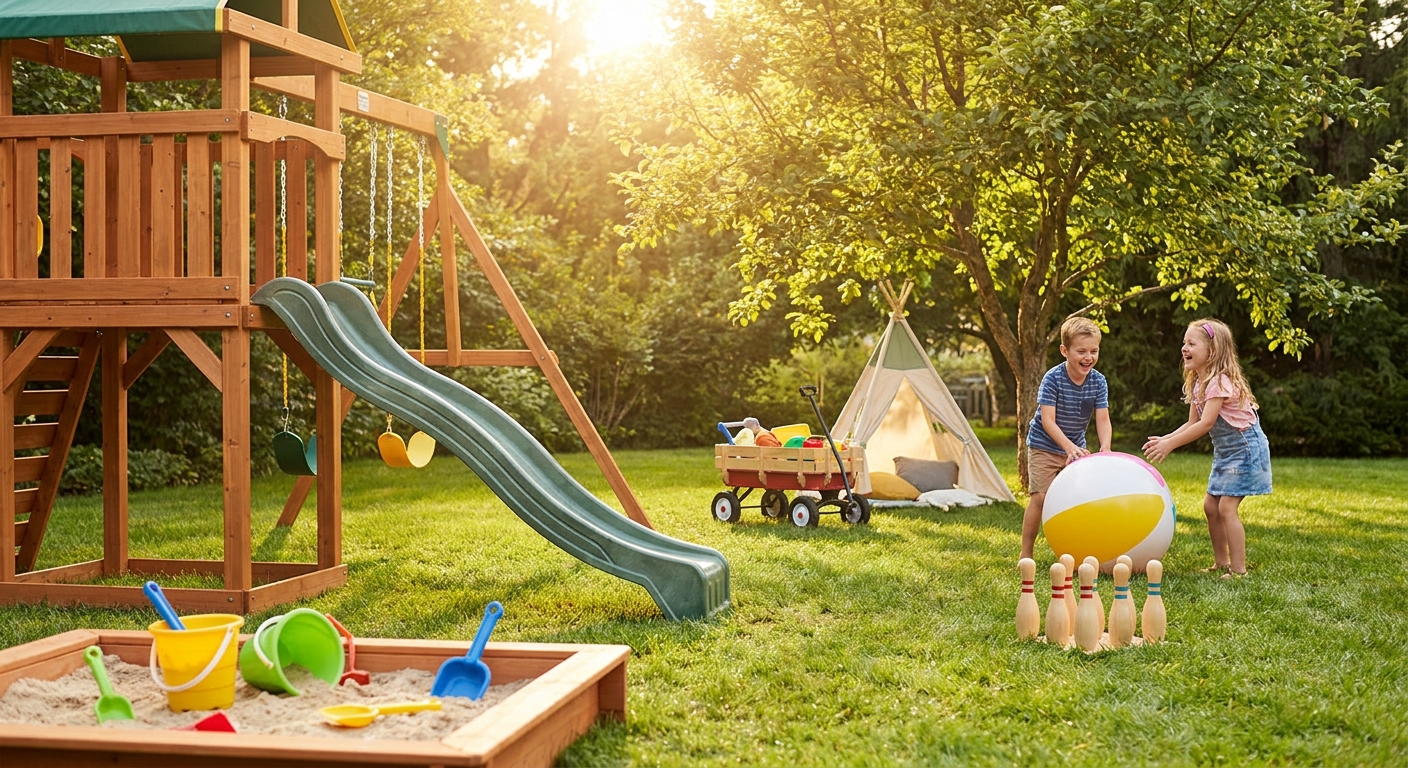
Sandpits — the toddler zone. A covered sandpit with a UV-rated lid keeps sand dry and pest-free between uses. Best suited to ages 1-5; interest drops sharply once kids hit primary school age. Consider if you already have loose outdoor storage space for the sand bags; Skip if you don't have a spot to keep it covered.
Ride-on toys — the wildcard. Battery ride-ons and pedal cars both work, but battery units need a charge cycle before every use and typically run 45-60 minutes per charge. Pedal versions have no charge time and lower long-term maintenance. Consider pedal-based ride-ons for driveways and paved courtyards; Skip battery units if your yard is grass-only, since wheels bog down fast.
Swing sets — the big investment. Frame thickness matters more than height here; anything under 32mm galvanised steel tends to flex and bend within a season of Australian weather. These need permanent or semi-permanent installation. Wait unless you've confirmed frame gauge and ground-anchor requirements — this is the category most likely to disappoint on a budget spec.
What to avoid
- Toys with no stated age range — a missing age label usually means the manufacturer skipped choking-hazard testing rather than that the toy suits everyone.
- Trampolines sold without a net at a suspiciously low price — the net is the single biggest injury-prevention feature; a trampoline without one is a different (riskier) product, not a discount version of the same one.
- "Universal fit" ride-on batteries — generic replacement batteries often run lower voltage than the original spec, cutting run time in half and shortening motor life.
Verdict comparison
| Category | Best age range | Assembly | Weather durability | Verdict |
|---|---|---|---|---|
| Trampoline (10ft) | 5-14 | 30-60 min | High with UV-rated mat | Buy |
| Water play table | 1-6 | Under 10 min | Medium, fades after 2 seasons | Buy |
| Sandpit (covered) | 1-5 | Under 15 min | High if lid used consistently | Consider |
| Ride-on (pedal) | 2-6 | Under 20 min | High, minimal electronics | Consider |
| Swing set | 3-10 | 2+ hours | Depends on frame gauge | Wait |
FAQ
What outdoor toys for backyard play last longest in Australia?
UV-stabilised trampolines and covered sandpits last longest, typically two to three summers before material fatigue sets in. Cheaper untreated plastic toys often crack or fade within a single season of direct sun.
Is a trampoline or a swing set better value for a small backyard?
A trampoline is better value for a small backyard because it needs less clearance and no permanent ground anchoring. Swing sets need 2+ hours of assembly and a stable frame footprint that most small yards can't accommodate.
How much does a decent backyard trampoline cost in 2026?
Mid-size 10ft trampolines with a safety net typically sit in the budget-to-mid price bracket in 2026, and discount retailers running up to 30% off can bring that down further. Price alone doesn't guarantee AS/NZS certification, so check the listing.
What age is a sandpit suitable for?
Sandpits suit children aged roughly 1 to 5, with interest dropping off sharply once kids reach primary school age. A covered lid extends usable life by keeping sand dry and pest-free between play sessions.
Do ride-on toys need a lot of maintenance?
Battery ride-on toys need regular charging and occasional battery replacement, while pedal ride-ons need almost no maintenance. For grass yards, pedal versions also avoid the wheel-bogging issue battery units run into.
What safety certification should outdoor toys have?
Trampolines sold in Australia should reference AS/NZS 4989 specifically, not a generic safety claim. Smaller toys should carry clear age-range labelling tied to choking-hazard testing.
How do I pick outdoor toys for backyard play on a tight budget?
Prioritise cost-per-use over sticker price — a $40 sprinkler used daily all summer outperforms a $300 toy used twice a month. Watch for seasonal discount periods, since backyard toy pricing often drops ahead of summer in 2026.
Are battery-powered or pedal ride-on toys better for driveways?
Pedal ride-ons work better on paved driveways and courtyards because they need no charge cycle and have fewer parts to fail. Battery units are better suited to flat, obstacle-free paved surfaces rather than grass.
One last thing
The detail most shoppers skip is frame gauge on swing sets — a 32mm steel frame versus a thinner budget frame is the difference between a set that survives five Australian summers and one that needs replacing after two. Check that spec before anything else on a swing set listing in 2026, because it's rarely advertised prominently and it's the one number that predicts the whole product's lifespan.