Montessori educational toys for toddlers turn everyday play into skill-building, and picking the right ones in 2026 means knowing what actually supports development versus what just looks good in a nursery photo.
- Wooden shape sorters are the safe pick for 2026 - open-ended play with zero screens or batteries.
- Skip anything with pieces under 3cm for toddlers under 3 - choking risk outweighs the play value.
- Busy boards win for toddlers 18-36 months who are past basic stacking and ready for latches and zips.
- Cost per play matters more than sticker price - a $25 sorter used daily beats a $60 toy ignored after a week.
Why this matters
Toddlers aged 12 to 36 months are wiring fine motor skills, hand-eye coordination and independence through repetitive, hands-on play. Montessori educational toys are built around that idea - no batteries, no flashing lights, no built-in "win" state. The toy does one job and the child figures out how.
Parents shopping in 2026 face a flooded market of "Montessori-inspired" labels slapped on plastic toys that don't follow any of the actual principles. Knowing the difference before you buy saves money and stops a $40 toy from sitting untouched in a drawer by week three. You can browse the current toy range at Hot Deal Warehouse to see what's in stock before working through the checklist below.
Who this is for
This guide is for parents and carers of toddlers between 12 and 36 months who want toys that build real skills - grasping, sorting, stacking, problem-solving - without paying premium prices for a label. If you're comparing a $70 branded "Montessori" set against a $25 wooden sorter and wondering if the difference is worth it, this is the comparison you need.
What to look for in montessori educational toys
Open-ended play value
A good Montessori toy has no single "correct" outcome - a set of stacking rings can be sorted by size, colour, or stacked in reverse order. Toys with only one right answer teach a toddler to guess rather than reason, and they get abandoned faster.
Material safety and durability
Wood, silicone and untreated fabric outlast painted plastic by years, not months. Check for AS/NZS toy safety compliance on the packaging - Australian standards set minimum requirements for choking hazards and finish toxicity that matter most for toddlers who still mouth everything.
Age-matched difficulty
A shape sorter designed for 12-18 months has 3-4 large shapes; one for 24-36 months should have 6-plus shapes with finer distinctions. Buying above the age band leads to frustration, buying below it leads to boredom within a week.
Self-correcting design
The best Montessori pieces let a toddler see their own mistake - a puzzle piece that won't fit, a ring that wobbles when stacked wrong. This is what builds independence, because the toy teaches instead of the parent correcting every attempt.
Size and choking-hazard compliance
Any loose piece under roughly 3cm is a hazard for children under three, full stop. Practical life sets with small tongs, beads or pom-poms need direct supervision and are better suited to the top of the 12-36 month range, not the bottom.
Cost per play, not sticker price
A $25 toy your toddler reaches for daily for six months costs less per use than a $60 toy played with twice. Track how many times a toy actually gets pulled off the shelf before judging the price.
Top picks for toddlers in 2026
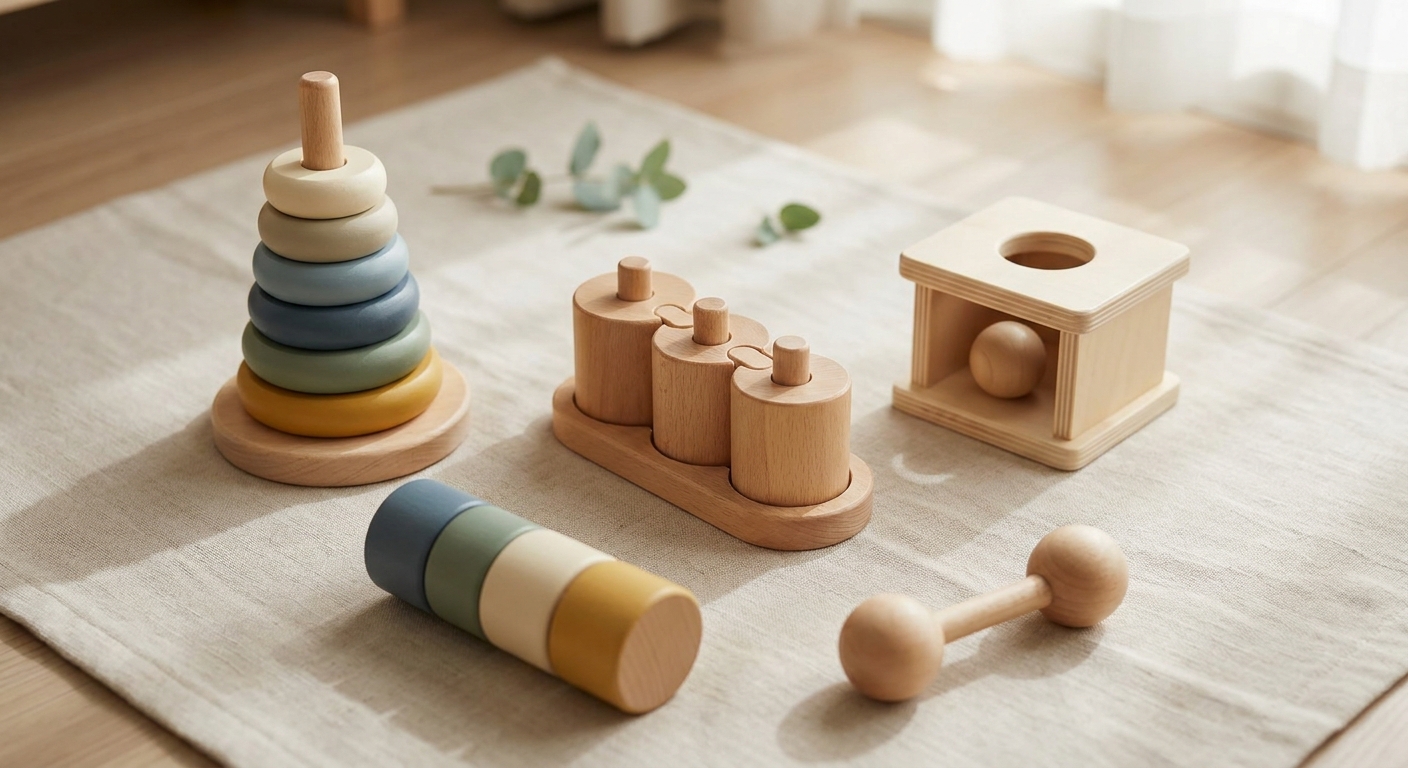
Wooden shape sorters - the safe pick. Look for 4-6 shapes with a solid base weight so it doesn't tip during play; this is the toy that survives the most drops and still teaches spatial reasoning at 12-24 months. Buy.
Stacking rings - the classic. A 5-to-7-ring set with graduated sizing keeps toddlers engaged past the usual two-week novelty window because it scales in difficulty as they get better at it. Buy.
Sensory sorting trays - the wildcard. Trays with 3-4 compartments and matching objects (colours, textures, shapes) work well for toddlers who've mastered basic sorting and need a step up in complexity. Consider.
Busy boards - the all-rounder. A board with 6-plus activities (zips, latches, buckles) suits 18-36 month olds building fine motor strength for dressing themselves later. Buy.
Practical life sets - the skill-builder. Pouring and spooning sets with small components need supervision and suit the older end of the range, closer to 30-36 months. Consider, and only with pieces above 3cm.
What to avoid
- Battery-operated "Montessori" toys - the moment a toy lights up or makes sound on its own, it stops being open-ended and starts training passive watching instead of active problem-solving.
- Oversized character-branded playsets marketed with the Montessori label but built around a single scripted outcome - these are traditional toys wearing a trend word.
- Toys with loose pieces under 3cm for children under three - no exceptions, regardless of educational claims on the box.
Verdict comparison
| Toy type | Best age | Material | Skill focus | Verdict |
|---|---|---|---|---|
| Wooden shape sorter | 12-24 months | Solid wood | Spatial reasoning | Buy |
| Stacking rings | 12-30 months | Wood or silicone | Fine motor, sequencing | Buy |
| Sensory sorting tray | 20-36 months | Wood or fabric | Categorisation | Consider |
| Busy board | 18-36 months | Wood, mixed hardware | Independence, dressing skills | Buy |
| Practical life set | 30-36 months | Wood, metal | Coordination | Consider (supervised) |
FAQ
What age should a toddler start with montessori educational toys?
Toddlers can start with simple Montessori toys like large shape sorters and stacking rings from 12 months. By 24-36 months they're ready for busy boards and multi-step sorting trays with finer distinctions.
Are montessori educational toys worth the extra cost over regular plastic toys?
Wood-based Montessori toys typically cost more upfront but last years longer than painted plastic, which lowers the real cost per play. A $25-40 wooden sorter used daily for a year beats a $15 plastic toy replaced three times.
Is a busy board better than a shape sorter for a 2-year-old?
A busy board suits a 2-year-old better than a basic shape sorter because it offers 6 or more activities instead of one, matching a toddler's growing attention span and fine motor skill range.
How much do montessori educational toys cost in 2026?
Basic wooden sorters and stacking sets run roughly $20-40 in 2026, while busy boards and multi-activity sets sit in the $40-70 range depending on the number of activities included.
Do montessori toys need to be made of wood?
No - wood is preferred for durability and lack of plastic additives, but silicone and untreated fabric also meet Montessori principles as long as the toy is open-ended and self-correcting.
Are Montessori-labelled toys always genuinely Montessori?
No - many toys use the word as a marketing label without following open-ended, self-correcting design principles. Check for single-outcome mechanisms or battery operation as red flags.
What's the biggest safety mistake parents make buying toddler toys?
Buying toys with loose pieces under 3cm for children under three is the most common mistake, regardless of the educational claims printed on the packaging.
One last thing
The simplest toy in the lineup - a plain wooden stacking ring set - usually gets more actual play hours across 2026 than any multi-feature busy board, because toddlers return to open-ended toys long after novelty items get shelved. Hot Deal Warehouse runs discounts of up to 30% off across toys and home essentials, so it pays to compare a few options before locking in one set.