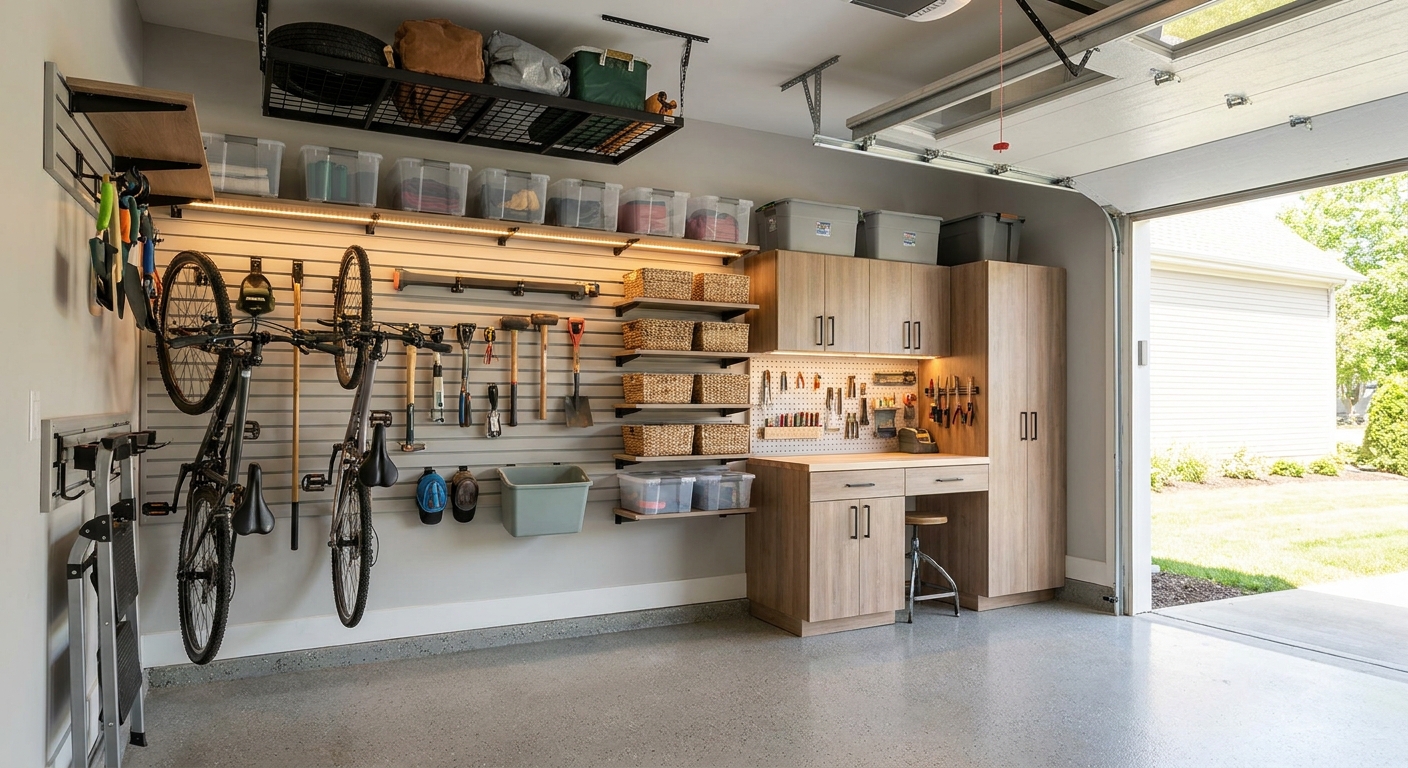
Small garage, big mess — that's the reality in most Australian homes, and the right garage storage solutions turn a car-clogged jumble into a stacked, usable space without a renovation.
- Wall-mounted slatwall panels win for small garages in 2026 — they hold up to 50kg per section and cost nothing in floor space.
- Overhead ceiling racks reclaim up to 3 square metres of floor area — buy for seasonal gear, skip if your ceiling height is under 2.4m.
- Stackable clear totes beat cardboard boxes for garage storage solutions — moisture resistant and stack four high without buckling.
- Freestanding cabinets are the wildcard: consider only if you have 60cm of spare floor width, otherwise skip.
Why this matters
A single garage in Australia is built to hold one car and not much else, yet it ends up storing tools, sports gear, seasonal decorations, and whatever didn't fit inside the house. Cram all of that onto the floor and you lose the one thing the garage was meant to do — park the car.
The fix isn't more space. It's smarter use of the space you already have, mostly the walls and ceiling that sit empty 95% of the time. Get this right in 2026 and you park the car, find your tools in under a minute, and stop tripping over bins at 6am.
Who this is for
This guide is for homeowners and renters working with a single-car or tandem garage under 20 square metres — the kind where a ride-on mower, three bikes, and a box of Christmas decorations already eat half the floor. If you're choosing between a $2,000 custom cabinetry system and a weekend DIY fix with off-the-shelf home essentials, this is written for the second group.
What to look for in garage storage solutions for small garages
Wall space before floor space
Floor space in a small garage is the scarcest resource you have — every square metre on the ground is a square metre you can't park in. Wall-mounted systems, from slatwall panels to simple bracket shelves, move storage vertically and leave the floor clear for the car and for walking.
Weight capacity and mounting hardware
A shelf that looks sturdy in the showroom can sag under a box of tools within weeks if the wall anchors aren't rated for the load. Check the stated capacity per shelf or per hook — most household-grade wall systems in 2026 top out around 30-50kg per bracket, which covers paint tins and power tools but not a full engine block.
Weatherproofing for the Australian climate
Garages run hotter and more humid than the rest of the house, especially through an Australian summer, and cardboard boxes soften and mould faster than most people expect. Plastic totes with sealed lids hold up through heat and damp far better than paper-based storage.
Modular and expandable systems
A small garage today might become a home gym or workshop corner next year, so a storage system that only works one way locks you in. Modular slatwall or track systems let you add a shelf, a hook, or a bin holder later without replacing the whole setup.
Stackable and see-through storage
Opaque boxes hide their contents, which means you end up opening four bins to find one extension cord. Clear stackable totes solve this instantly and stack safely up to four high in most small garages.
Quick-install for renters
If you're renting, drilling into brick or Colorbond isn't always an option. Look for freestanding or adhesive-mount systems that don't require permanent fixing and can move with you.
Top picks for small garage storage
1. Wall-mounted slatwall panels — the space multiplier
Slatwall systems turn a bare garage wall into a fully configurable storage grid, with hooks, baskets, and shelves that slot in wherever you need them. A single 1.2m panel typically holds up to 50kg once anchored into studs, enough for a full set of garden tools and a couple of paint tins.
They cost more upfront than basic shelving but pay off because they're reconfigurable — move a hook six inches when your setup changes instead of buying new brackets. For a small garage where every wall matters, this is the pick that does the most with the least floor footprint. Verdict: Buy for anyone with more gear than wall space.
2. Overhead ceiling racks — the overhead escape route
Ceiling-mounted racks use the one part of a small garage nobody else is fighting for — the airspace above the car. A standard rack reclaims roughly 3 square metres of usable storage without touching the floor, which is ideal for bulky seasonal items like Christmas decorations or camping gear that only comes out twice a year.
The catch is ceiling height — anything under 2.4m clearance and you'll be ducking every time you walk in. Measure before you buy. Verdict: Consider if your garage has the headroom, Skip if it doesn't.
3. Stackable clear totes — the see-through fix
Swapping cardboard boxes for stackable, clear plastic totes is the cheapest single upgrade on this list and arguably the one with the fastest payoff. Totes in the 20L to 60L range stack four high without buckling and keep contents visible, so you stop opening five boxes to find the jumper cables.
They're not glamorous, but they solve the two biggest small-garage problems at once: moisture damage and wasted search time. Verdict: Buy — this is the starting point before any bigger system.
4. Pegboard tool organizers — the tool tamer
A pegboard panel mounted near your workbench keeps hand tools visible and off the bench top, which matters most in a garage where the bench doubles as the only flat surface for everything else. A full 1.2m pegboard setup with hooks generally runs $30 to $60 at Australian hardware retailers, making it one of the lowest-cost fixes on this list.
It's not a whole-garage solution on its own, but paired with wall shelving it clears clutter fast. Verdict: Buy for anyone who owns more than a screwdriver and a hammer.
5. Freestanding cabinets — the wildcard
Freestanding metal or plastic cabinets look like the obvious answer because they're what most hardware stores push first. The problem in a small garage is footprint — a typical unit needs 60cm of floor depth plus door swing clearance, which can eat the exact space you're trying to free up.
They work in garages with awkward corners no wall system can use, but as a first move for a small garage, they usually make the parking problem worse before they make storage better. Verdict: Skip unless you have a genuinely dead corner to fill.
If your small garage doubles as gear storage for a home gym setup, keeping the space organized matters as much as keeping your training kit sorted — the best men's gym clothes for training in Australia guide covers what's worth keeping on a hook versus in a drawer.
What to avoid
- Cardboard boxes stacked directly on the floor — they wick moisture from concrete and soften within a season in most Australian climates.
- Oversized modular wall systems bought for a bigger garage — a system designed for a double garage often leaves 30-40% of a single-garage wall unusable once installed.
- Floor cabinets bought before measuring door swing — a cabinet that opens into your car's door path defeats the purpose of a small-garage fix.
Verdict comparison
| Solution | Floor footprint | Typical capacity | Best for | Verdict |
|---|---|---|---|---|
| Slatwall panels | None (wall) | Up to 50kg per panel | Tools, sports gear | Buy |
| Overhead ceiling rack | None (ceiling) | Bulky seasonal items | Camping/decorations | Consider |
| Stackable clear totes | Minimal | 20-60L per tote | General storage | Buy |
| Pegboard organizer | None (wall) | Hand tools | Workbench areas | Buy |
| Freestanding cabinet | 60cm+ | Mixed | Dead corners only | Skip |
FAQ
What's the best garage storage solution for a small garage in 2026?
Wall-mounted slatwall panels are the best starting point for most small garages in 2026 because they add storage without using floor space. Pair them with stackable clear totes for anything that doesn't hang on a hook.
Is overhead garage storage better than wall shelving?
Overhead racks and wall shelving solve different problems — overhead suits bulky, rarely-used items like seasonal decorations, while wall shelving suits tools and gear you reach for often. Most small garages need both, not one or the other.
How much weight can garage wall shelving hold?
Household-grade wall shelving typically holds 30-50kg per bracket when anchored into wall studs. Anything heavier, like an engine or full toolbox, needs a rated freestanding unit instead.
Are plastic totes better than cardboard boxes for garage storage?
Yes — plastic totes resist the heat and humidity that soften cardboard in an Australian garage within a season. Clear totes add the bonus of seeing contents without opening every box.
Do I need permanent fixtures for garage storage if I'm renting?
No, freestanding shelving units and adhesive-mount hook systems avoid drilling into brick or Colorbond walls. They cost slightly more per unit of storage but move with you when you relocate.
How much floor space does garage storage furniture actually take up?
A typical freestanding cabinet needs about 60cm of depth plus door swing clearance, which is why wall and ceiling systems are usually the better first move in a small garage. Floor cabinets work best for dead corners a car or wall system can't reach.
What garage storage mistakes should I avoid in a small space?
The biggest mistake is buying a system sized for a double garage, which can leave 30-40% of a single-garage wall unusable once mounted. The second is stacking cardboard directly on concrete, where moisture damage sets in fast.
One last thing
The single upgrade that changes a small garage the fastest isn't a big-ticket system — it's swapping every cardboard box for a clear stackable tote, because the visibility alone cuts search time to seconds and the plastic shrugs off the heat and damp that ruins cardboard by mid-2026 summer. Start there before spending on wall panels or ceiling racks.